
Posted on: Nov 03, 2026
Insights from Workshop E at SSON Shared Services & Outsourcing Week Autumn 2026, Amsterdam
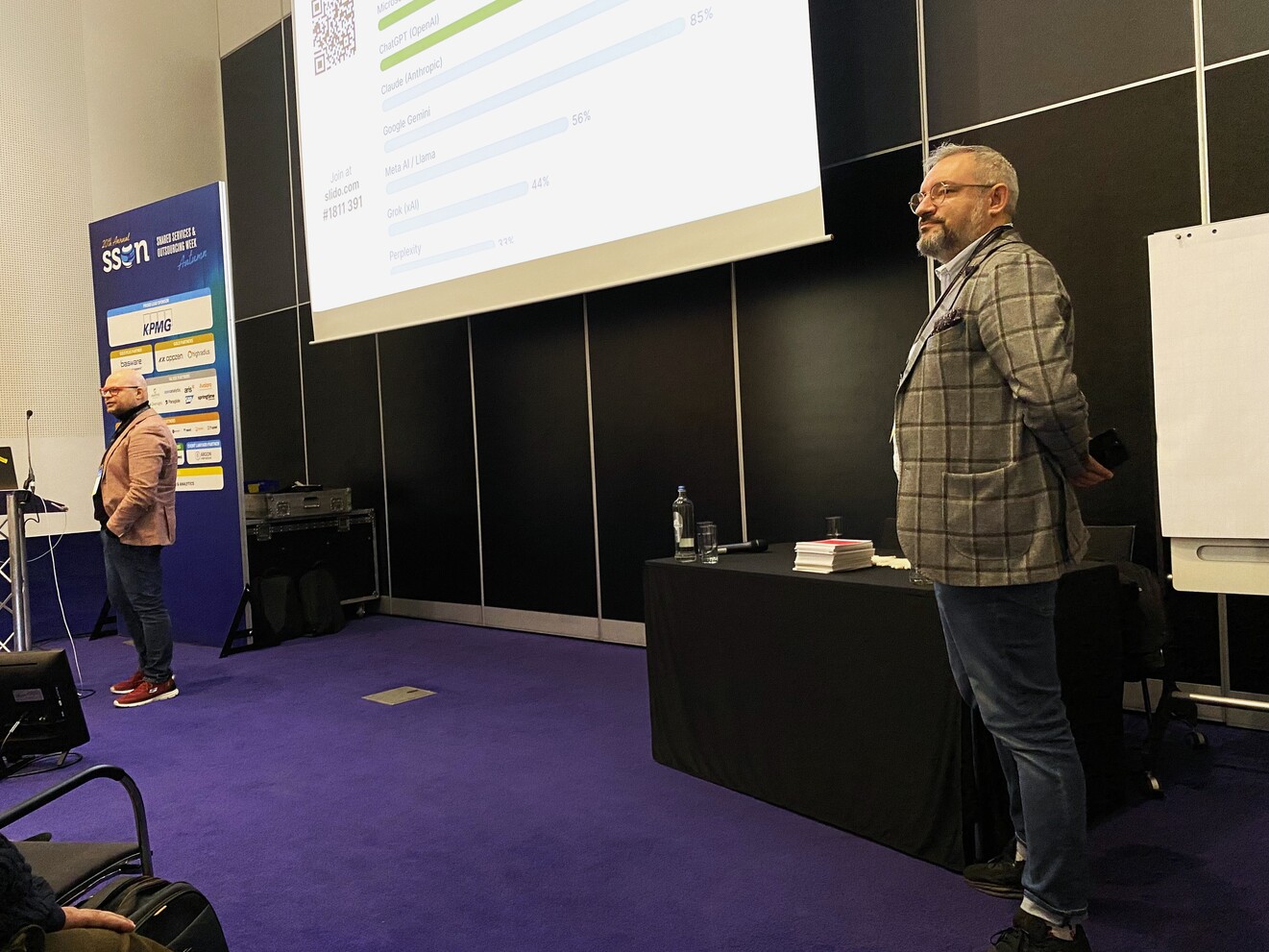
For years, technology barriers slowed Global Business Services down. Requirements travelled through layers of analysts, tickets waited in IT backlogs, and solutions arrived months later, often misaligned with what the business actually needed. At the 20th Annual SSON Shared Services & Outsourcing Week in Amsterdam, Paweł Płocki, Associate Partner, and Robert Godziszewski, Executive Business Director at Adaptive Group, invited participants to look at this problem from a new angle. AI is about to remove these barriers, but only for organisations that prepare now.
The cost of getting technology wrong
The numbers behind traditional IT delivery are sobering. Around 70% of IT implementations fail to deliver what was promised. According to Bain, 88% of business transformations miss their original ambitions, while Gartner reports that 75% of ERP implementations exceed their scope, budget or timeline. Research from Standish Group and Pendo adds that 64% of software features built are rarely or never used. In other words, organisations have spent billions and still too often get it wrong.
Why implementations really fail
The workshop pointed to a crucial insight: technology is rarely the root cause. Only 20–30% of implementation success depends on the technology itself, while the rest comes down to people and process. The most common reasons for failure are poor user adoption (70–75%), business–IT misalignment (50–63%), wrong requirements (45–64%) and skills gaps (87%).
The traditional delivery model builds these risks in by design. A business user describes a need, a business analyst reinterprets it, a technical analyst writes specifications, and developers build something after a cycle of 6 to 18 months. Every handoff adds noise, delay and drift. The result is a system that is technically correct but functionally useless: users rely on a fraction of its features, create workarounds from day one, and the promised ROI never materialises.
AI changes who builds the solution
Generative AI and no-code/low-code platforms are rewriting this equation. Tools such as ChatGPT, Claude, Copilot and Power Apps are already in use today, and they allow GBS operations teams to build solutions themselves. The business identifies a need, and the people closest to the process create the tool with AI assistance. The solution reflects the exact requirements from day one, is deployed in days or weeks rather than months, and enjoys natural adoption because it was built by the people who use it. IT remains in the picture as a strategic platform partner that governs, secures and scales what the business creates.
Three real gains of business-led development
The workshop highlighted three tangible benefits. The first is precision: tools built by people who know the process work the first time, with no requirements lost in translation and no features nobody asked for. The second is speed. Business-led development can be 3–5× faster than traditional IT pipelines, moving from idea to working solution in days instead of waiting in a 12-month queue. The third is adoption: when you build a tool yourself, you use it, which means no training problem and no shadow spreadsheets on day one.
A practical SSC/GBS example illustrates the point. A finance team used Copilot and Power Apps to build an accounts payable reconciliation tool in two days, while the same request had been sitting in the IT queue for six months. The business-built version achieved 100% adoption from day one.
What this means for IT: roles evolve, they don’t disappear
An honest conversation about this shift must include its impact on IT. Roles focused on building business-facing apps on request, translating business needs into requirements, writing specifications between teams, or maintaining legacy backlogs of internally built apps are evolving away. At the same time, demand is growing for DevOps engineers, cloud and infrastructure architects, cybersecurity specialists and a new role, AI and automation governance lead.
This is not the end of IT, but a redefinition of its value. IT moves from builder to strategist and owns three critical areas: building the guardrails through security standards and review protocols, owning the platform of cloud, data, identity and integration, and validating and deploying business-created solutions through code review and production governance. For strong IT professionals, this is not a demotion but a promotion to strategic architecture.
A practical roadmap: from acknowledging the shift to the new normal
The technology is ready, but organisations are not. The workshop therefore outlined a three-stage path. Today, organisations should acknowledge the shift: recognise AI-assisted development as a present trend, start small, low-risk and measurable pilots, map the IT roles already under pressure, and open a dialogue between IT and business. Within 6–12 months, they should build the governance: establish rules for AI-built apps, upskill IT towards DevOps and cybersecurity, train business users in responsible AI usage, and define what the business can build and what IT must validate. Within 1–3 years, business-led development becomes the standard model, IT operates as a platform team rather than a dev shop, governance and security become IT’s primary value, and organisational change management competencies emerge as the key differentiator.
Follow or lead
The central question is not whether this change will happen, but whether organisations will follow or lead. Business leaders should ask themselves whether they are waiting 18 months for something that doesn’t match their needs, or actually building solutions that do. IT leaders face an equally important choice: maintain a backlog of the past, or move beyond delivery into strategic leadership.
As Adaptive Group put it during the workshop: AI doesn’t replace IT, it relocates where value is created. GBS Ops and IT teams that align now on governance, skills and platform will lead the next decade. Those who treat this as someone else’s problem will follow.
To help you recall the entire presentation, we invite you to take a look at our presentation -> Workshop E_ No More Technology Barriers – SSOW Autumn 2026
Let’s continue the conversation
Participants of the workshop were encouraged to explore tools such as Google AI Studio and Lovable.dev to experience business-led development first-hand. If you would like to discuss how your organisation can prepare for a world without technology barriers, contact Robert Godziszewski (robert.godziszewski@adaptivesag.com) or Paweł Płocki (pawel.plocki@adaptivesag.com).